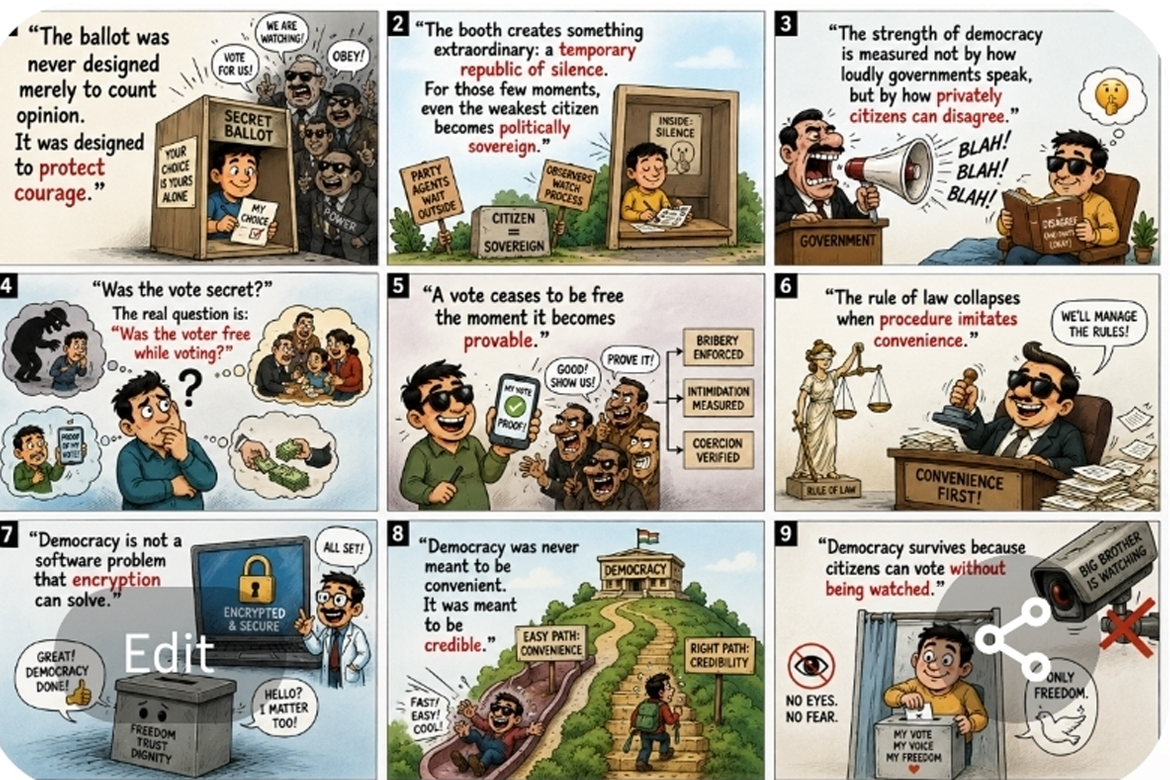
“The ballot was never designed merely to count opinion. It was designed to protect courage.”
There is a dangerous modern assumption quietly entering democratic discourse:
“If technology can conduct voting, democracy must automatically approve it.”
Nothing can be constitutionally more naïve.
The right to vote is not a software feature.
It is a protected democratic condition.
And the “secret ballot” is not a decorative phrase buried inside election manuals. It is the invisible wall standing between the citizen and organized power.
The tragedy of digital enthusiasm is that modern systems often preserve the appearance of secrecy while silently destroying the conditions necessary for secrecy.
That distinction is where constitutional law begins.
THE GREAT MISUNDERSTANDING:
Secret Ballot Does NOT Mean Mere Hidden Voting
Many people simplistically assume:
“If nobody can see the vote on screen, secrecy is preserved.”
That is technologically attractive
But constitutionally shallow.
A secret ballot means far more than concealed preference.
It means:/p>
- voting without fear,
- voting without supervision,/li>
- voting without coercion,
- voting without proof,
- voting without psychological pressure.
Democracy protects not merely the vote — it protects the loneliness of the voter.
WHY PHYSICAL VOTING STILL COMMANDS CONSTITUTIONAL RESPECT
There is a reason why democracies across the world spent centuries constructing polling booths instead of WhatsApp elections.
The physical polling booth is not accidental architecture. It is constitutional engineering.
Inside a physical polling station:
- the voter enters alone,
- the State guarantees privacy,
- political agents remain outside,
- observers monitor procedure,
- ballots remain auditable,
- and secrecy is institutionally enforced.
The booth creates something extraordinary: a temporary republic of silence.
For those few moments, even the weakest citizen becomes politically sovereign.
“The strength of democracy is measured not by how loudly governments speak, but by how privately citizens can disagree.”
EVMs ARE NOT ONLINE VOTING
This confusion must end immediately.
Indian EVMs are NOT internet elections.
They are:
- offline,
- isolated,
- stand-alone,
- physically supervised machines.
The voter still walks into a controlled polling booth.
The secrecy environment still exists.
The democratic structure still survives.
EVMs merely digitized the recording of votes.
They did not privatize the environment of voting.
That distinction changes everything.
WHY ONLINE VOTING CREATES CONSTITUTIONAL PANIC/h3>
Online voting does something historically unprecedented:/p>
“it relocates democracy from supervised public institutions into uncontrolled private spaces.”
The polling booth disappears.
Institutional oversight collapses.
The election enters the living room.
And once voting leaves the protected constitutional environment, the law loses its ability to verify freedom.
THE REAL QUESTION IS NOT:
“Was the vote secret?”
The real question is:
“Was the voter free while voting?”
That is the constitutional test.
And online systems fail spectacularly at answering it.
THE INVISIBLE COERCION OF ONLINE VOTING
Consider the realities nobody discusses honestly.
Can the system verify:
- who is standing beside the voter?
- whether family members are influencing the vote?
- whether committee members are supervising?
- whether credentials were shared?
- whether elderly voters are being controlled?
- whether votes are being purchased through screenshot proof?
Absolutely not.
And this is where democracy becomes dangerously fragile.
“A vote ceases to be free the moment it becomes provable.”
SCREENSHOTS:
The Death Certificate of Secret Ballot
Physical ballots historically prohibited proof.
Why?
Because once voters can prove whom they voted for:
- bribery becomes enforceable,
- bribery becomes enforceable,
- coercion becomes verifiable.
Online voting destroys this firewall instantly.
Screenshots. Screen recordings. Live supervision. Shared OTPs.
Democracy slowly transforms into digitally managed obedience.
HYBRID VOTING:
The Worst of Both Worlds
Hybrid voting sounds sophisticated. Legally, it is deeply unstable.
Why?
Because one class of voters receives:
- controlled secrecy,
- supervised polling,
- institutional protection.
Another class votes:
- remotely,
- unsupervised,
- technologically exposed,
- psychologically vulnerable.
The election now operates under two different constitutional realities.
Democracy becomes unequal at the point of voting itself.
POSTAL BALLOTS:
The Exception That Proves the Rule
People often argue:
«“But postal ballots already exist.”»
True. But postal ballots survive only because:
- they are statutory exceptions,
- narrowly regulated,
- administratively necessary,
- and constitutionally tolerated despite known weaknesses.
Nobody seriously argues that postal ballots represent the ideal democratic model.
In fact, postal ballots themselves acknowledge a constitutional compromise.
Online voting attempts to convert that compromise into the main system.
That is profoundly dangerous.
THE SUPREME COURT HAS ALREADY WARNED US
The Supreme Court in PUCL v. Union of India observed:
«“Secrecy of ballot is an indispensable adjunct of free and fair elections.”»
And in A.C. Jose v. Sivan Pillai:
«“Executive instructions cannot supplant statutory rules.”»
These judgments contain a deeper warning:
Democracy cannot be redesigned through administrative convenience.
THE BYE-LAW PROBLEM NOBODY WANTS TO DISCUSS
In society elections, resident welfare associations, clubs and associations, the issue becomes even more serious.
If bye-laws contemplate:
- physical meetings,
- ballots,
- quorum,
- member presence,
- polling procedures.
then online or hybrid voting cannot magically emerge through executive notification.
Technology cannot amend bye-laws.
Convenience cannot override legality.
And a caretaker administration certainly cannot acquire constitutional creativity merely because it possesses software.
“The rule of law collapses quietly when procedure begins to imitate convenience.”
THE BIGGEST ILLUSION OF THE DIGITAL AGE
Modern systems confuse:
encryption with democracy.
These are not the same things.
A technologically secure vote may still be constitutionally insecure.
Because democracy requires far more than cybersecurity.
It requires:
- public confidence,
- visible integrity,
- equal participation,
- coercion-free voting,
- institutional transparency,
- and protected political solitude.
DEMOCRACY WAS NEVER MEANT TO BE CONVENIENT
This may sound uncomfortable, but constitutional systems are intentionally slow, procedural and visible.
Why?
Because liberty is fragile.
The polling booth exists not because democracies distrust citizens — but because democracies distrust power.
And history repeatedly proves they were right.
FINAL THOUGHT
The future may indeed involve technology. But constitutional democracies must ask a harder question before embracing digital voting systems:
“Can technology preserve not merely the secrecy of votes, but the freedom of voters?”
That question remains dangerously unanswered.
Until then, the humble polling booth continues to protect something no software has yet successfully replicated
the silent independence of the human conscience.
“Democracy survives not because citizens vote. Democracy survives because citizens can vote without being watched.”
— Ravindra Babu
Attorney
Master Key Attorneys
8985006444 / 7444
Masterkeyattorneys@gmail.com